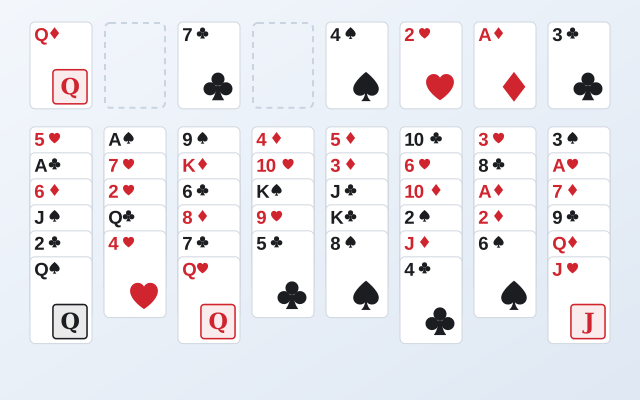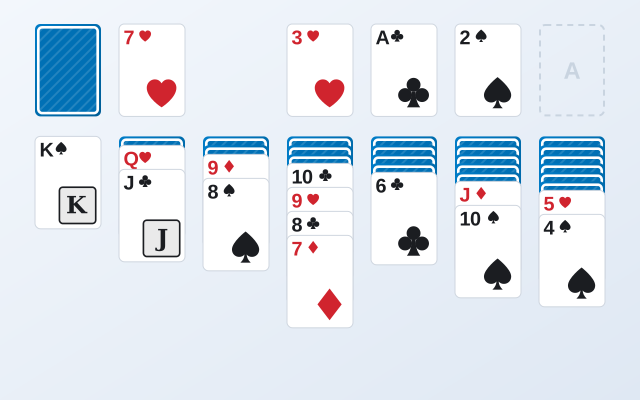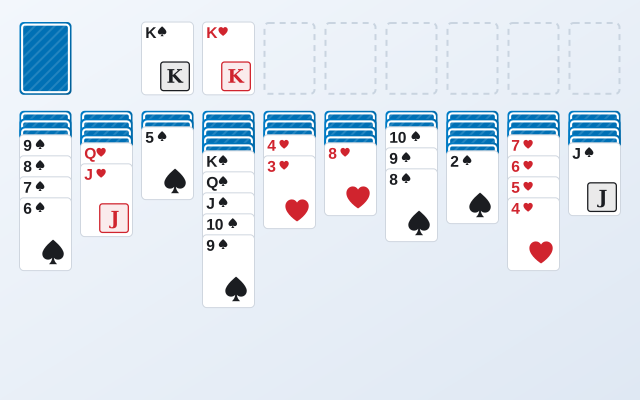
In FreeCell every card is dealt face up, so there is nothing hidden to blame. Almost every deal can be won with four free cells; the difference between a win and a dead end is planning.
Here is how to think about a deal. Put it into practice in FreeCell, which also offers three or two free cells when you want a harder game.
Read the deal before the first move
Find the four aces and the twos. Note how many cards sit on top of each. The aces buried deepest decide the shape of the game, because every card above them has to find a home first.
Then look for natural runs already in place, such as a 7 sitting on an 8 of the opposite colour. They are free progress and tell you which columns will be easy to clear.
Free cells are a resource, not storage
Each free cell holds one card. It is tempting to park cards there to reach something, but every full cell makes the next move harder and limits how many cards you can move at once.
Before filling a cell, know how you will empty it. A good move uses a cell for a moment and gives it straight back.
Empty columns are worth even more
An empty column can take any card or run, and it doubles the number of cards you can move together. Clearing a short column early is often the strongest move on the board.
Keep the column empty as long as you can. Fill it with a single card only when that unlocks something important, and prefer to fill it with a long run headed by a high card.
How many cards can move at once
Strictly, FreeCell moves one card at a time. Moving a run is a shortcut for shuffling its cards through free cells and empty columns, so the size of run you can move depends on the space you have:
Cards you can move = (free cells + 1) × 2 ^ (empty columns)
- 4 free cells, no empty column: 5 cards.
- 4 free cells, 1 empty column: 10 cards.
- 2 free cells, 1 empty column: 6 cards.
- 4 free cells, 2 empty columns: 20 cards.
When the run is moving into an empty column, that column does not count, so with four free cells and one empty column you can move a run of 5 into it. Aback Games does this arithmetic for you and only allows moves that could be made card by card.
Work toward the low cards
The foundations build up from the aces, so low cards are the bottleneck. Aim each sequence of moves at uncovering an ace, a two or a three. Once the low cards are up, the rest of the game usually falls into place.
Aback Games moves cards to the foundations automatically when it is safe: aces, twos, and any card whose lower opposite-colour cards are already up, since nothing could still need it.
Playing with fewer free cells
With three or two cells, every cell matters twice as much, and runs shrink: with two cells and no empty column you can only move three cards together. Clear a column early, avoid parking cards that have no quick way out, and take longer over the opening.
Questions
Can every FreeCell deal be won?
Almost every deal with four free cells can be won, but a very small number cannot. With fewer free cells, more deals become unwinnable.
What is a supermove?
Moving a whole run in one go. It stands for the single-card moves you could make using free cells and empty columns, which is why the run size is limited by (free cells + 1) × 2 to the power of the empty columns.
Is an empty column better than an empty free cell?
Yes. A free cell holds one card, while an empty column can hold a whole run and doubles how many cards you can move at once.