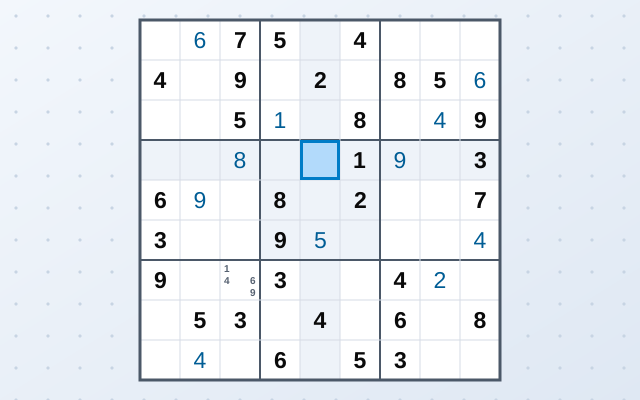
A good Sudoku never needs a guess. Each puzzle has exactly one solution, and every square can be filled by a logical step. The steps get harder as the puzzles do, but there are only a handful of them, and each one is a simple idea.
This guide goes through them in the order you will need them. Every Sudoku on Aback Games is graded by the hardest technique it needs, so you can practise each level with the techniques below.
The rule, and the three kinds of unit
Every row, every column and every 3 × 3 box must hold the digits 1 to 9 once each. Rows, columns and boxes are called units. Each square belongs to three units, and every technique is about what those units still need.
Hidden singles: scanning
Pick a digit and a box that is missing it. Every row and column that already contains that digit rules out the squares it passes through. If only one square in the box is left, the digit goes there. This is a hidden single, and it is how most people solve the start of every puzzle.
Hidden singles work in rows and columns too: if a row needs a 7 and only one of its empty squares can take one, that square is the 7.
Start with the digits that are already placed most often. When seven 5s are on the board, the last two are usually quick to find.
Naked singles: what fits in one square
Turn it around and look at a single square. Cross off every digit already in its row, column and box. If only one digit is left, it must go there. This is a naked single.
Easy and Medium puzzles on Aback Games need nothing more than hidden and naked singles. Medium ones just hide them better.
When to start writing notes
Once singles dry up, write pencil notes: the small digits that could still go in each square. It feels slow, but the harder techniques are almost impossible to see without them.
In Aback Games, placing a digit removes the same note from its row, column and box automatically, so your notes stay correct as you play.
Pointing pairs and triples
Look at one box and one digit. If every square in the box that can hold that digit lies in the same row, the box must put its digit in that row. So no other square in that row, outside the box, can have it. Remove the note from the rest of the row.
The same works with a column. With two possible squares it is called a pointing pair, with three a pointing triple.
Box-line reduction
This is the reverse. If, within one row, a digit can only go in squares that all sit inside the same box, then the row will put its digit in that box. Every other square in that box, outside the row, loses that note.
Naked pairs and triples
If two squares in a unit hold exactly the same two notes, say 3 and 8, those two digits are used up by those two squares, even if you do not know which goes where. Remove 3 and 8 from every other square in that unit.
A naked triple is three squares in a unit whose notes, together, are only three digits, such as 1 and 4, 4 and 9, and 1 and 9. Those three digits can be removed from the rest of the unit. Not every square needs all three notes.
Hidden pairs and triples
Sometimes the pair is hidden among other notes. If, in a row, the digits 2 and 6 can each only go in the same two squares, those two squares must be 2 and 6. Every other note in those two squares can be erased.
Hidden triples follow the same idea with three digits confined to three squares of a unit.
Hard puzzles on Aback Games need pointing pairs, box-line reductions or naked and hidden pairs. Expert puzzles go on to triples and the X-wing.
The X-wing
Choose a digit and look at the rows. Suppose in two different rows that digit can only go in two squares each, and those squares line up in the same two columns. The two rows must put their digits in those columns, one in each, at opposite corners of a rectangle.
Either way round, both columns get their digit from those two rows. So the digit can be removed from every other square in those two columns. The same pattern works with columns and rows swapped.
If you get stuck
- Check your notes. A missing note is the most common reason a technique seems not to apply.
- Go back to scanning. A single often appears after a note is removed somewhere else.
- Look at units with only two or three empty squares; they are where pairs show up.
- Use a hint. In Aback Games a hint fills in the easiest next square and explains why, so you learn the step rather than skip it.
Questions
Do you ever need to guess in Sudoku?
Not in a well-made puzzle. Every Sudoku on Aback Games is checked to have exactly one solution and to be solvable by logical techniques alone.
What is the difference between a naked single and a hidden single?
A naked single is a square where only one digit fits. A hidden single is a digit that can only go in one square of a row, column or box, even if that square still has other notes.
Which technique should I learn after singles?
Pencil notes, then pointing pairs and naked pairs. Together they solve most hard puzzles.