
Strategy
Checkers
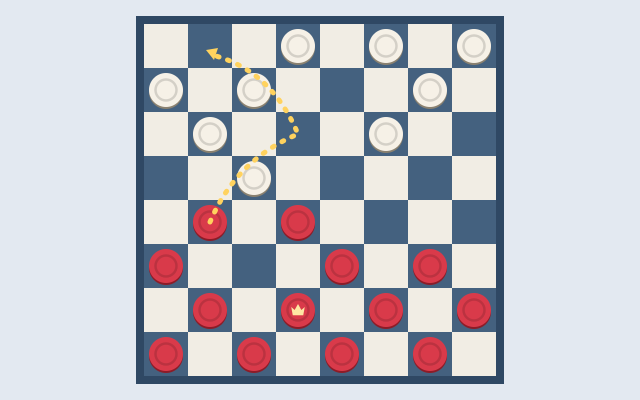
The classic board game of jumps and kings. Capture every piece of the computer, or leave it with no move.
- Keyboard
- Touch
Play a full game of chess against the computer, as White or Black, at three levels. Every rule is in: castling, en passant, promotion and every draw.
Pieces the AI has taken: none
Promote your pawn to
Pieces you have taken: none
Loading the board…
Click a piece, then the square to move it to, or drag it. With the keyboard, move between squares with the arrow keys and press Enter to pick up and put down.Tap a piece, then the square to move it to, or drag it.
Chess is the classic two-player strategy game: each side has sixteen pieces, and the goal is to checkmate the other king, attacking it so that it cannot escape. Here you play against a computer opponent that can be gentle or genuinely tough.
Play as White and move first, or as Black and answer the AI’s opening. Every rule of the game is built in, the move list shows the game in standard notation, and a game in progress is saved in your browser, so you can come back to it.
| Choose a piece, then its square | Click, or Enter on the focused square |
|---|---|
| Move a piece | Drag it to its square |
| Move between squares | Arrow keys (Tab reaches the board) |
| Put a chosen piece back | Esc |
| New game | N |
| Sound on or off | M |
| Choose a piece, then its square | Tap them |
|---|---|
| Move a piece | Or drag it |
The king moves one square in any direction. The queen moves any distance in a straight line or diagonally; the rook in straight lines; the bishop diagonally. The knight jumps in an L shape, two squares one way and one the other, over anything in between.
A pawn moves straight forward one square, or two from its starting square, and takes diagonally forward. No piece may pass through another, except the knight, and you take a piece by moving onto its square.
Castling: if your king and a rook have not moved, the squares between them are empty, and the king is not in check and does not pass through or land on an attacked square, the king moves two squares toward the rook and the rook jumps over it.
En passant: when a pawn moves two squares and lands beside one of your pawns, your pawn may take it as if it had moved one square, but only on the very next move.
Promotion: a pawn that reaches the last rank becomes a queen, rook, bishop or knight of your choice.
A king that is attacked is in check, and you must get out of check at once. You may never make a move that leaves your own king in check. If you are in check and cannot escape, it is checkmate and the game is lost.
The game is drawn by stalemate (no legal move but not in check), when the same position comes up three times, after fifty moves each with no capture or pawn move, or when neither side has enough pieces left to checkmate.
Your wins, losses and draws against each level are kept in this browser.
Easy looks one move ahead and adds randomness, so it often misses threats. Medium looks about three moves ahead. Hard searches as deep as it can in under a second, usually five to seven moves ahead, and plays out captures before it judges a position.
No. It only sees the board, like you. It searches possible moves in your browser and picks the one it rates best, with some randomness on the easier levels.
Yes. The game in progress is saved in this browser after every move and picked up when you return. Starting a new game or finishing one clears it.
Not here: Chess on Aback Games is single-player against the computer.
Strategy
The classic board game of jumps and kings. Capture every piece of the computer, or leave it with no move.
Strategy
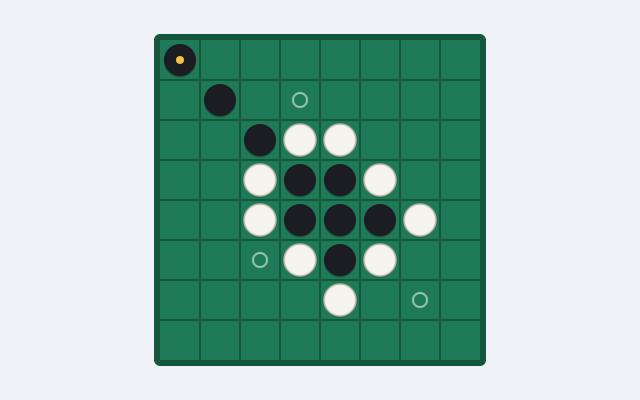
Outflank the computer on an 8 × 8 board: every disc you trap in a line flips to your side. Most discs at the end wins.
Strategy
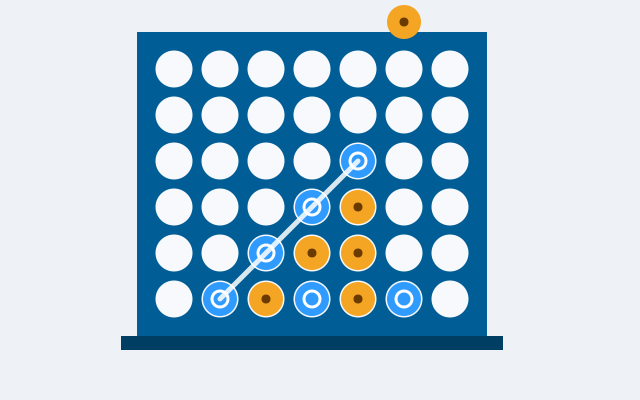
Drop discs into the grid and line up four of yours before the computer does: across, down or diagonally.