
Puzzle
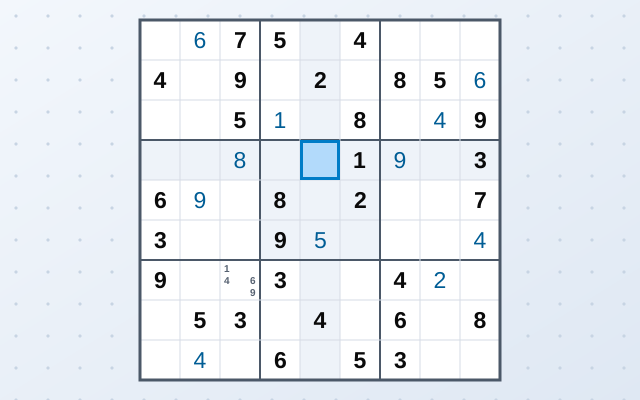
Sudoku
Fill the grid so every row, column and box holds 1 to 9. Four levels, pencil notes, hints and your progress saved as you go.
- Keyboard
- Touch
Fill in a grid from the number clues on each row and column. Every puzzle has one answer, and logic alone can find it.
Loading the puzzle…
Click a cell to fill it, or right-click to cross it out. Drag to mark a row of cells at once. With the keyboard, move with the arrow keys, press Space to use the tool, F to fill, X to cross out and Delete to clear.Tap a cell to fill it, or switch the tool to Cross out. Slide your finger to mark several cells in a row.
Nonograms are logic puzzles drawn on a grid. Each row and column has a clue, a list of numbers, telling you the lengths of the runs of filled cells in that line, in order. Work out which cells are filled, and a shape appears.
Every puzzle here is generated fresh and checked by a solver before you see it: it has exactly one answer, and it can be solved one line at a time by logic, so you never need to guess. Your best time for each size is kept in this browser.
| Fill a cell, or clear it | Click it |
|---|---|
| Cross out a cell | Right-click it |
| Mark several cells in a line | Drag across them |
| Move between cells | Arrow keys (Tab reaches the grid) |
| Use the tool, fill, cross out, clear | Space, F, X, Delete |
| Switch between Fill and Cross out | T |
| Hint | H |
| Undo | U |
| New puzzle | N |
| Sound on or off | M |
| Fill a cell, or clear it | Tap it |
|---|---|
| Cross out cells | Switch the tool to Cross out, then tap |
| Mark several cells in a line | Slide your finger across them |
Each number is a run of filled cells in that row or column, given in order from left to right or top to bottom. Runs are separated by at least one blank cell. A clue of 0 means the whole line is blank.
For example, in a row of ten cells the clue "8" leaves only two ways to place the run, and the middle six cells are filled either way.
Puzzles are made at random, then smoothed so the filled cells form shapes rather than scattered dots. A puzzle is only used if a solver can complete it by looking at one row or column at a time, which proves there is one answer that needs no guessing.
The shapes are abstract, not pictures of things.
A hint first fixes a cell you have marked wrongly. If every mark is right, it fills in or crosses out a cell that one clue proves, and tells you which clue.
Your best time at each size is kept in this browser, and a puzzle in progress is saved so you can come back to it. A puzzle finished with hints counts as solved, but not as a best time.
No. Every puzzle is checked before you see it: it can be solved by reasoning about one row or column at a time.
They go by many names, including griddlers, paint by numbers, hanjie and picture logic puzzles. The rules are the same.
Only to you. They are notes for cells you know are blank; the puzzle only checks which cells are filled.
Puzzle
Fill the grid so every row, column and box holds 1 to 9. Four levels, pencil notes, hints and your progress saved as you go.
Puzzle
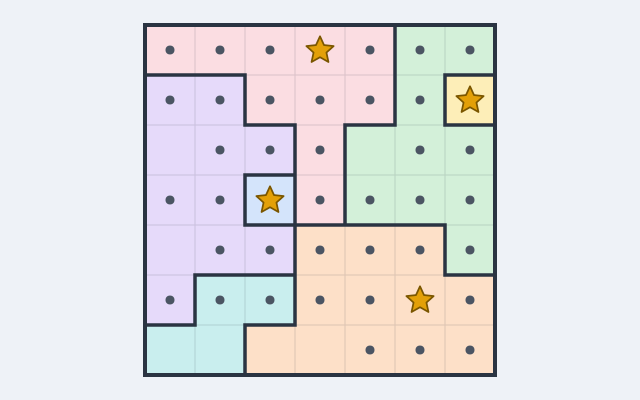
Place one star in every row, column and coloured region, without letting any two stars touch.
Puzzle
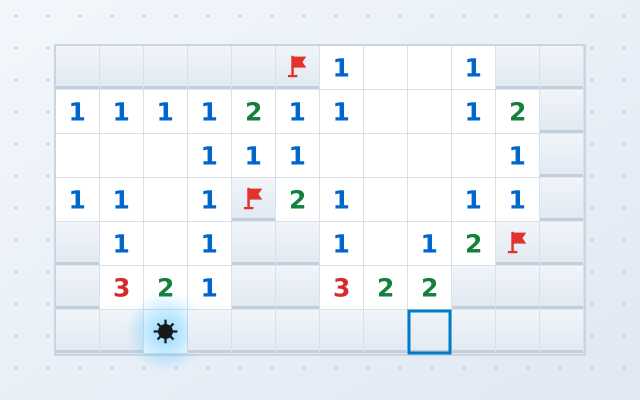
Clear the minefield using the numbers as clues. Three levels, flags, chording and a first click that is always safe.