Most chess games between beginners are not won by deep plans. They are won by the player who stops giving pieces away first. This guide covers the handful of habits that do that, then the tactics and endgames that turn an advantage into a win.
Everything here can be practised in Chess against the computer, as White or Black, at three levels.
Know what your pieces are worth
Players use a simple scale to judge trades:
- Pawn: 1
- Knight: 3
- Bishop: 3
- Rook: 5
- Queen: 9
- King: cannot be traded; losing it loses the game
Before you take a piece, count what you give up in return. Taking a pawn with your queen is fine if the queen is safe afterwards; trading your rook for a knight loses two points. The numbers are a guide, not a law, but they stop most bad trades.
Opening principles
You do not need to memorise openings. Follow these and you will reach a sound position in most games:
- Put a pawn or two in the centre: e4, d4, e5 or d5.
- Bring out your knights and bishops before anything else, ideally each one once.
- Castle early, usually on the king side, to tuck your king away and connect your rooks.
- Keep the queen at home for the first few moves. Brought out early, it gets chased around while the other side develops.
- Do not grab far-off pawns while your pieces are still at home.
Check every move: checks, captures, threats
Before each move, look at the board from your opponent’s side and ask three questions: which checks can they give, which of my pieces can they capture, and what does their last move threaten?
Then ask the same about your own move: after it, is anything of yours left undefended? A piece that is attacked and not defended is called hanging, and hanging pieces decide most beginner games.
This one habit, done every move, does more for your results than any opening.
The tactics that win material
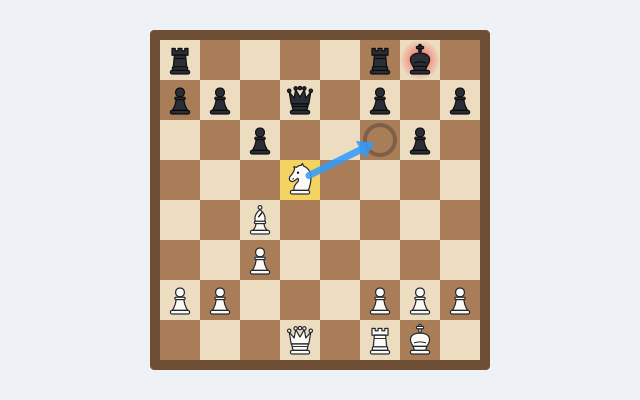
- Fork: one piece attacks two at once. Knights are the best at it, because their jumps are easy to miss. A knight check that also hits a rook or queen usually wins it.
- Pin: a piece cannot move without exposing a more valuable piece behind it. A bishop pinning a knight to the king freezes the knight completely.
- Skewer: the reverse of a pin. You attack a valuable piece; when it moves, you take the one behind it.
- Discovered attack: moving one piece uncovers an attack by another. If the moving piece also attacks something, the opponent cannot answer both.
Look for these whenever two enemy pieces, or a piece and the king, stand on the same line or a knight’s jump apart.
Finishing the game
Being ahead is not enough; you need to checkmate. Practise these until they are automatic:
- King and queen against king: use the queen to shrink the enemy king’s box a little at a time, bring your own king up, then mate on the edge. Watch out for stalemate: always leave the lone king a square to move to until the final move.
- Two rooks against king: the rooks take turns checking along ranks, walking the king to the edge.
- Passed pawns: a pawn with no enemy pawns in front of it or on the files beside it. Push it, with your king nearby, and it will often become a queen.
In the endgame the king becomes a strong piece. Bring it toward the centre once the queens are off the board.
Beating each computer level
Easy looks only one move ahead and adds randomness, so it often leaves pieces hanging. Take free material, keep your own pieces defended, and simplify by trading when you are ahead.
Medium looks about three moves ahead, so it sees short tactics. Do not leave pieces hanging, castle early, and aim for longer plans it cannot see, such as a pawn majority on one side that becomes a passed pawn.
Hard searches as deep as it can in under a second, usually five to seven moves ahead, and plays out captures before judging a position. Play solid chess: develop, castle, avoid weaknesses around your king, and look for endgames where long-term plans matter more than short tactics.
Playing as Black against any level is a little harder, because White moves first.
The special rules
Castling: the king moves two squares toward a rook and the rook jumps over it. Neither may have moved, the squares between must be empty, and the king may not be in check, pass through an attacked square or land on one.
En passant: when a pawn moves two squares and lands beside one of your pawns, your pawn may take it as if it had moved one square, but only on the very next move.
Promotion: a pawn that reaches the far side becomes a queen, rook, bishop or knight. Almost always pick the queen; a knight only when its check wins something at once.