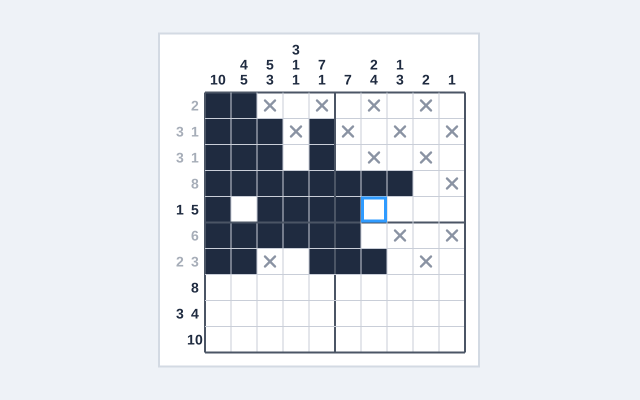
A nonogram is a grid with a clue beside every row and above every column. Each clue lists the runs of filled cells in that line, in order. Your job is to work out which cells are filled.
Every puzzle in Nonograms can be solved one line at a time by the techniques below, without guessing. Cells are counted from the left (or the top) in the examples.
Reading a clue
A clue of 3 1 in a row of ten means a run of three filled cells, then at least one blank, then a single filled cell. The runs keep their order, but the gaps can be any size. A clue of 0 means the whole line is blank.
The overlap: cells every arrangement shares
Slide a run as far left as it can go, then as far right. The cells it covers in both positions must be filled.
In a row of 10 with the clue 7, the run covers cells 1 to 7 at the far left and 4 to 10 at the far right. Cells 4, 5, 6 and 7 are filled either way.
A quick way to see it: the slack is the line length minus the clue (10 − 7 = 3). A run longer than the slack overlaps by the difference (7 − 3 = 4 cells).
With several runs, add them up plus one blank between each to get the total. The slack is the line length minus that total, and every run longer than the slack overlaps by the difference.
Example: a row of 10 with the clue 3 4. The total is 3 + 1 + 4 = 8, so the slack is 2. The 3 overlaps by one cell (cell 3), and the 4 by two cells (cells 7 and 8).
Lines the clue fills completely
If the total equals the line length, there is no slack and the line is decided outright. In a row of 10, the clue 4 5 totals 4 + 1 + 5 = 10: cells 1 to 4 are filled, 5 is blank, 6 to 10 are filled.
The same goes for a clue equal to the line, such as 10 in a row of 10, and for 0.
Cross out what must be blank
As soon as a line has all its runs, cross out every cell left in it. Crosses are only notes for you, but they are the information the crossing lines need.
Cells out of reach of every run are blank too. If the only run in a row is a 2 and you have filled cell 5, then cells 1 to 3 and 7 onward are too far away to belong to it.
Use the edges
A filled cell in the first cell of a line, or straight after cells that are all crossed out, must be the start of the first run. If the first run is 4, the next three cells are filled and the one after them is blank. The same works from the other end with the last run.
This is how small facts from one line become whole runs in another.
Work rows against columns
Every cell you fill or cross out belongs to a row and a column. After each new mark, look at the line that crosses it: the new fact often lets you apply the overlap or the edge rule there.
A good rhythm is: do every row once, then every column, then the rows again. The grid fills faster with each pass.
When you are stuck
Pick the line with the least slack that is not finished and try placing its first run in every possible spot. Any cell that comes out the same in every placement is yours.
On Aback Games a hint first fixes a cell you marked wrongly, then fills in a cell that a single clue proves and tells you which clue, so you can see the reasoning.