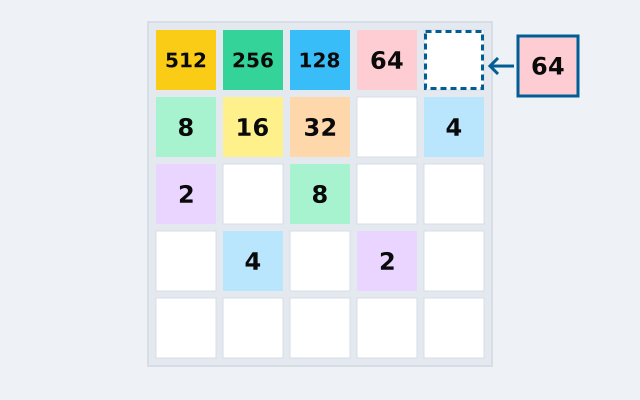
In Twofold you choose where every tile goes, so a lost game is always a board that filled up with tiles that could not meet. These habits keep the 5×5 board open long enough to build 1024.
Build in a corner, in order
Put your biggest tile in a corner and grow a line from it: the biggest, then half of it, then half again, along an edge. When the smallest tile in that line doubles, it can meet the next one, and the whole line can collapse into the corner in a single move.
For example, with 128, 64 and 32 in a row, placing a 32 beside the 32 makes 64, which joins the 64 to make 128, which joins the 128 to make 256.
Place for the second merge, not just the first
A merged tile appears on the cell you placed on. So when you have a choice of cells next to a match, pick the one where the result will also touch its equal. One well-placed tile can climb three or four steps.
Before each move, ask: after this merge, what does the new tile touch?
Space is everything
Every merge frees at least one cell; every tile that does not merge uses one up. Try to place tiles where they will be able to merge soon, and avoid scattering odd values across the middle of the board, where they block lines.
Look at the Next tile too. If it matches something on the board, keep a cell free beside that tile.
Clear small tiles before they are stranded
The tiles that arrive grow with your best tile: the smallest is your best tile divided by 16. Once your best tile reaches 64, no more 2s arrive; at 128, no more 4s. A 2 left on the board after that can only merge with another 2 that is already there, so it may sit in its cell for the rest of the game.
When your best tile is getting close to the next step, tidy up the smallest tiles first.
Use your undo wisely
You get one undo per game. Keep it for a real mistake, such as a tile placed in the one cell your chain needed, rather than for trying out a move.