
Strategy
Twofold strategy: how to build a 1024 tile
Where to put your biggest tile, how to set up chain merges, why space matters more than score, and what to do about small tiles left behind.
2 min read
A number merge puzzle: place each tile anywhere on a 5×5 board, and touching equal tiles join into one double. Can you build 1024?
Arriving now: 2 to 16
Goal: a 1024 tile
Click an empty cell, or move with the arrow keys and press Enter. U undoes once per game.Tap an empty cell to place the tile. Two equal tiles that touch merge into one double.
Twofold is a number merge puzzle where you decide where every tile goes. Each turn you get one tile, a 2, 4, 8 or bigger, and place it on any empty cell of a 5×5 board. When it touches a tile of the same value, the two join into one tile worth double.
Merges can chain: two 8s make a 16, which joins a neighbouring 16 to make 32, and so on. Keep building towards a 1024 tile before the board fills up. There is no sliding and no timer, so every move is yours to plan.
| Choose a cell | Arrow keys (Tab reaches the board) |
|---|---|
| Place the tile | Enter or Space, or click the cell |
| Undo the last move | U (once per game) |
| New game | N |
| Sound on or off | M |
| Place the tile | Tap an empty cell |
|---|---|
| Undo or new game | Tap the buttons above the board |
Tiles touch when they share a side; corners do not count. When the tile you place touches one or more tiles of the same value, the whole touching group becomes one tile of double the value, on the cell you placed on. Three 8s in a group still make a single 16, so a group of more than two wastes tiles.
After a merge, the new tile checks its own neighbours and merges again if it can, so one placement can climb several steps. Because of this, two equal tiles never stay side by side.
Arriving tiles depend on your best tile. The smallest is your best tile divided by 16, but never less than 2; the others are 2, 4 and 8 times that. So you start with 2, 4, 8 and 16, and once your best tile reaches 64 the smallest arrival becomes 4. The chances are 45%, 30%, 15%, 10% from smallest to largest. The range arriving now is shown above the board.
Small tiles left on the board after the range moves up can still merge with each other, but no new tiles of that size will come. Clear them while you can.
Every merge scores the value of the tile it makes, so a chain scores each step. You get one undo per game. Your game in progress is saved in this browser, so you can leave and come back. Your best score, best tile, games played and games that reached 1024 are saved on this device.
Strategy
Where to put your biggest tile, how to set up chain merges, why space matters more than score, and what to do about small tiles left behind.
2 min read
Puzzle
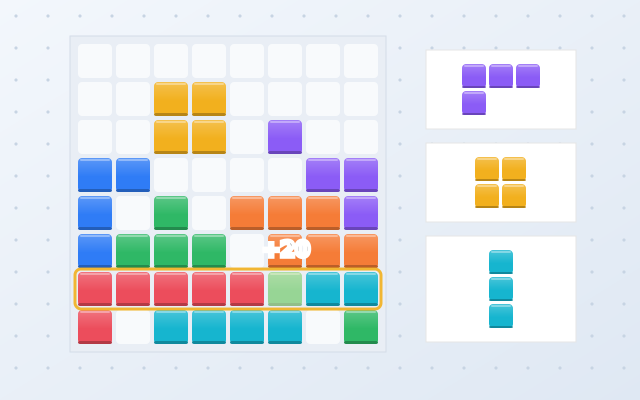
Drag blocks onto the grid and complete rows and columns to clear them. Chain clears into streaks and keep the board open as long as you can.
Puzzle
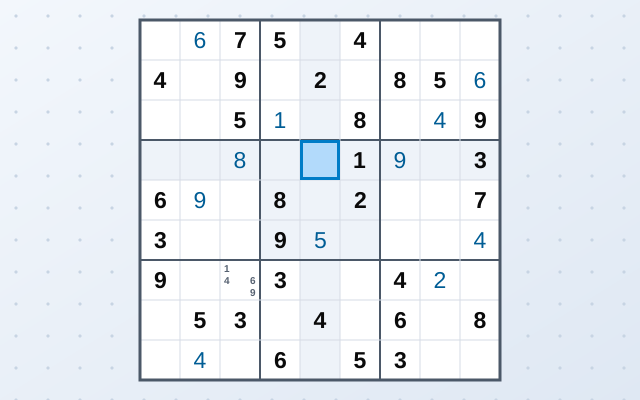
Fill the grid so every row, column and box holds 1 to 9. Four levels, pencil notes, hints and your progress saved as you go.
Developer
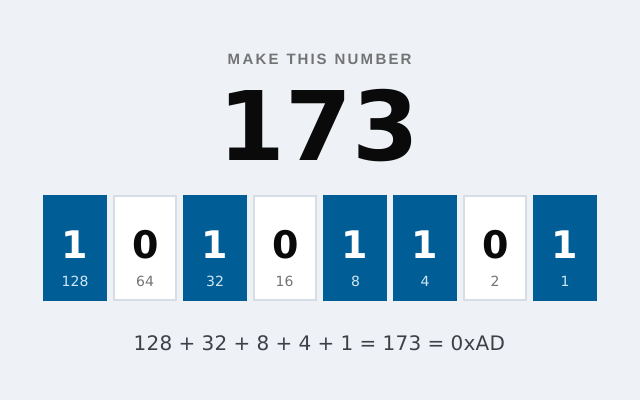
Flip bits to build each number in binary. How many can you make in 60 seconds?